




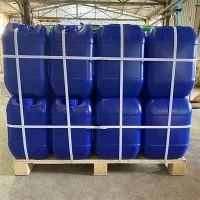
As a supplier of TBHP (Tert-butyl Hydroperoxide), ensuring the purity of our product is of utmost importance. The purity of TBHP not only affects its performance in various applications but also determines its safety during storage and use. In this blog post, I will discuss several methods that can be used to determine the purity of TBHP.
Titration Method
One of the most common methods for determining the purity of TBHP is titration. This method is based on the reaction of TBHP with a reducing agent. Potassium iodide (KI) is often used as the reducing agent in the titration of TBHP.
The reaction between TBHP and KI in an acidic medium can be represented by the following equation:
[ \text{TBHP} + 2\text{KI} + 2\text{H}^+ \rightarrow \text{tert - butanol}+\text{I}_2 + \text{H}_2\text{O} + 2\text{K}^+ ]
The iodine ((\text{I}_2)) produced in the reaction is then titrated with a standard solution of sodium thiosulfate ((\text{Na}_2\text{S}_2\text{O}_3)) using starch as an indicator. The end - point of the titration is reached when the blue color of the starch - iodine complex disappears.
The purity of TBHP can be calculated based on the volume and concentration of the sodium thiosulfate solution used in the titration. The following steps are involved in the titration process:
- Sample Preparation: A known amount of the TBHP sample is accurately weighed and dissolved in a suitable solvent, usually a mixture of acetic acid and chloroform.
- Addition of KI: An excess amount of potassium iodide is added to the sample solution. The mixture is then allowed to react for a certain period of time to ensure complete reaction between TBHP and KI.
- Titration with (\text{Na}_2\text{S}_2\text{O}_3): The iodine produced in the reaction is titrated with a standard solution of sodium thiosulfate. The volume of the sodium thiosulfate solution used at the end - point is recorded.
- Calculation of Purity: The purity of TBHP is calculated using the following formula:
[ \text{Purity}(%)=\frac{V\times C\times M\times 100}{m\times n} ]
where (V) is the volume of the sodium thiosulfate solution used (in liters), (C) is the concentration of the sodium thiosulfate solution (in mol/L), (M) is the molar mass of TBHP, (m) is the mass of the TBHP sample (in grams), and (n) is the stoichiometric factor (in this case, (n = 2) because 1 mole of TBHP reacts with 2 moles of (\text{Na}_2\text{S}_2\text{O}_3) through the iodine intermediate).
Gas Chromatography (GC)
Gas chromatography is another powerful technique for determining the purity of TBHP. GC can separate the components of a sample based on their volatility and affinity for the stationary phase in the column.
In the analysis of TBHP, a suitable column and detector are selected. A capillary column with a non - polar stationary phase is often used. The detector can be a flame ionization detector (FID) or a mass spectrometer (MS).
The sample is injected into the GC system, and the components are separated as they pass through the column. The detector then measures the amount of each component based on its response. The purity of TBHP can be determined by comparing the peak area of TBHP with the total peak area of all the components in the chromatogram.
The advantages of using GC for purity determination include high sensitivity, good resolution, and the ability to identify impurities. However, GC requires specialized equipment and trained personnel to operate.
Nuclear Magnetic Resonance (NMR) Spectroscopy
NMR spectroscopy is a non - destructive technique that can provide detailed information about the structure and purity of a compound. In the case of TBHP, (^1\text{H}) NMR and (^{13}\text{C}) NMR can be used.
In (^1\text{H}) NMR, the chemical shifts and coupling constants of the hydrogen atoms in TBHP can be used to identify the compound and detect the presence of impurities. The integration of the peaks in the (^1\text{H}) NMR spectrum can also be used to estimate the purity of TBHP.
For example, the methyl groups in TBHP give characteristic peaks in the (^1\text{H}) NMR spectrum. The presence of additional peaks may indicate the presence of impurities such as Di - Tert - Butyl Peroxide or other by - products.
Similarly, (^{13}\text{C}) NMR can provide information about the carbon atoms in TBHP. The chemical shifts of the carbon atoms in TBHP are distinct, and any deviation from the expected values may indicate the presence of impurities.
The advantage of NMR spectroscopy is that it can provide structural information about the compound and its impurities. However, NMR spectroscopy is relatively expensive and requires a high - field NMR spectrometer.
High - Performance Liquid Chromatography (HPLC)
HPLC is a widely used technique for the analysis of organic compounds. It can separate the components of a sample based on their interaction with a stationary phase and a mobile phase.
In the analysis of TBHP, a reversed - phase HPLC column with a suitable mobile phase is used. The mobile phase usually consists of a mixture of water and an organic solvent such as acetonitrile or methanol.
The sample is injected into the HPLC system, and the components are separated as they pass through the column. The detector, which can be a UV - Vis detector or a refractive index detector (RID), measures the amount of each component.
The purity of TBHP can be determined by comparing the peak area of TBHP with the total peak area of all the components in the chromatogram. HPLC is a relatively fast and sensitive method for purity determination, and it can be used to analyze samples with a wide range of polarities.


Infrared (IR) Spectroscopy
IR spectroscopy can be used to identify the functional groups in TBHP and detect the presence of impurities. TBHP has characteristic absorption bands in the IR spectrum due to the presence of the hydroperoxide group ((-\text{OOH})) and the tert - butyl group ((-\text{C}(CH_3)_3)).
The absorption bands at around 3400 - 3600 (cm^{-1}) are due to the stretching vibration of the (\text{O}-\text{H}) bond in the hydroperoxide group. The absorption bands at around 2900 - 3000 (cm^{-1}) are due to the stretching vibration of the (\text{C}-\text{H}) bonds in the tert - butyl group.
The presence of additional absorption bands in the IR spectrum may indicate the presence of impurities. For example, if there are absorption bands in the region characteristic of esters or alcohols, it may indicate the presence of by - products or contaminants.
IR spectroscopy is a relatively simple and fast method for purity determination, but it is less quantitative compared to titration, GC, or HPLC.
Importance of Purity Determination
The purity of TBHP is crucial in many applications. In the chemical industry, TBHP is used as an oxidizing agent in various organic synthesis reactions. Impurities in TBHP can affect the reaction rate, selectivity, and yield of the synthesis reaction.
In the polymer industry, TBHP is used as a polymerization initiator. The purity of TBHP can affect the molecular weight, molecular weight distribution, and properties of the polymer.
In addition, the purity of TBHP is also important for safety reasons. Impurities can increase the reactivity of TBHP and pose a safety hazard during storage and handling. Therefore, accurate determination of the purity of TBHP is essential to ensure its quality and safety.
If you are interested in purchasing high - purity Tert - butyl Hydroperoxide or other organic peroxides such as DTAP | CAS 10508 - 09 - 5 | Di - tert - amyl Peroxide, please feel free to contact us for more information and to discuss your specific requirements. We are committed to providing high - quality products and excellent customer service.
References
- Skoog, D. A., West, D. M., Holler, F. J., & Crouch, S. R. (2014). Fundamentals of Analytical Chemistry. Cengage Learning.
- McMurry, J. (2016). Organic Chemistry. Cengage Learning.
- Silverstein, R. M., Webster, F. X., & Kiemle, D. J. (2014). Spectrometric Identification of Organic Compounds. Wiley.