





As a reliable supplier of the chemical with CAS 110-05-4, I am often asked about its reaction kinetics. In this blog post, I will delve into the details of the reaction kinetics of this chemical, providing you with a comprehensive understanding of its behavior in various chemical reactions.
Introduction to CAS 110-05-4
The chemical with CAS 110-05-4 is 2,2'-Azobis(2-methylpropionitrile), commonly known as AIBN. It is a well - known organic compound widely used as a free - radical initiator in polymerization reactions. AIBN has a white crystalline appearance and is soluble in many organic solvents such as chloroform, benzene, and ethanol.
Reaction Kinetics Basics
Reaction kinetics is the study of the rates at which chemical reactions occur, the factors that affect these rates, and the mechanisms by which the reactions proceed. The rate of a chemical reaction is usually expressed as the change in concentration of a reactant or product per unit time.
For a general reaction (aA + bB\rightarrow cC + dD), the rate law can be written in the form (r = k[A]^m[B]^n), where (r) is the rate of the reaction, (k) is the rate constant, ([A]) and ([B]) are the concentrations of reactants (A) and (B), and (m) and (n) are the reaction orders with respect to (A) and (B) respectively.
Decomposition Kinetics of AIBN
The primary reaction of AIBN that is of great interest in many applications is its thermal decomposition. At elevated temperatures, AIBN decomposes to form free radicals. The decomposition reaction can be represented as follows:
((CH_3)_2C(CN)-N = N - C(CN)(CH_3)_2\rightarrow2(CH_3)_2C(CN)^{\cdot}+N_2)
The decomposition of AIBN is a first - order reaction. The rate of decomposition (r) can be expressed as (r=k_d[AIBN]), where (k_d) is the decomposition rate constant and ([AIBN]) is the concentration of AIBN.
The decomposition rate constant (k_d) is highly dependent on temperature. The Arrhenius equation (k_d = A\exp(-E_a/RT)) describes this relationship, where (A) is the pre - exponential factor, (E_a) is the activation energy, (R) is the gas constant, and (T) is the absolute temperature.
Experimental studies have shown that the activation energy (E_a) for the decomposition of AIBN is approximately (128\ kJ/mol), and the pre - exponential factor (A) is around (10^{15}\ s^{- 1}). As the temperature increases, the value of (k_d) increases exponentially, leading to a faster decomposition of AIBN.
Influence of Solvent on Reaction Kinetics
The solvent in which the reaction takes place can have a significant impact on the reaction kinetics of AIBN. Different solvents have different polarities, dielectric constants, and solvation abilities, which can affect the stability of the free radicals formed during the decomposition of AIBN.
In polar solvents, the solvation of free radicals can occur, which may either stabilize or destabilize the radicals. For example, in a highly polar solvent, the free radicals may be more solvated, leading to a decrease in their reactivity. On the other hand, in non - polar solvents, the free radicals are less solvated and may be more reactive.
Reaction Kinetics in Polymerization Reactions
AIBN is widely used as an initiator in free - radical polymerization reactions. In a polymerization reaction, the free radicals generated from the decomposition of AIBN initiate the polymerization of monomers.
The overall rate of polymerization (R_p) is influenced by the rate of initiation ((R_i)), propagation ((R_p)), and termination ((R_t)). The rate of initiation is directly related to the rate of decomposition of AIBN. Once the free radicals are formed, they react with monomers to start the propagation step.
The rate of propagation (R_p = k_p[M][M^{\cdot}]), where (k_p) is the propagation rate constant, ([M]) is the concentration of the monomer, and ([M^{\cdot}]) is the concentration of the propagating free radicals. The rate of termination (R_t=k_t[M^{\cdot}]^2), where (k_t) is the termination rate constant.
The concentration of the propagating free radicals ([M^{\cdot}]) can be derived from the steady - state approximation, which assumes that the rate of initiation is equal to the rate of termination ((R_i = R_t)).
Comparison with Other Free - Radical Initiators
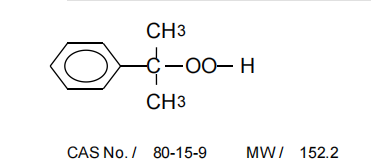
When considering the use of AIBN as a free - radical initiator, it is useful to compare its reaction kinetics with other common initiators. For example, TBPO | CAS 3006-82-4 | Tert - butylperoxy - 2 - ethylhexanoate and CHP | CAS 80-15-9 | Cumene Hydroperoxide are also widely used organic peroxides as free - radical initiators.
TBPO decomposes at a different rate compared to AIBN. Its decomposition is also a first - order reaction, but the activation energy and pre - exponential factor are different from those of AIBN. CHP, such as CHP90, also has its own unique decomposition kinetics. The choice of initiator depends on the specific requirements of the polymerization reaction, such as the desired reaction temperature, reaction rate, and the properties of the final polymer.
Factors Affecting the Use of AIBN in Industrial Applications
In industrial applications, several factors need to be considered when using AIBN based on its reaction kinetics. Temperature control is crucial because the decomposition rate of AIBN is highly temperature - dependent. If the temperature is too low, the decomposition rate will be slow, leading to a low rate of initiation and a slow polymerization reaction. If the temperature is too high, the decomposition may be too rapid, causing problems such as poor control of the reaction and potential safety hazards.
The purity of AIBN also affects its reaction kinetics. Impurities in AIBN can act as inhibitors or accelerators of the decomposition reaction, altering the rate of free - radical generation and thus the overall reaction rate.

Conclusion
Understanding the reaction kinetics of the chemical with CAS 110 - 05 - 4 (AIBN) is essential for its effective use in various chemical reactions, especially in free - radical polymerization. The decomposition of AIBN is a first - order reaction, and its rate constant is highly dependent on temperature. Solvent effects, reaction conditions, and the presence of impurities can all influence the reaction kinetics.
As a supplier of CAS 110 - 05 - 4, we are committed to providing high - quality products and technical support. If you are interested in purchasing AIBN for your chemical processes or have any questions regarding its reaction kinetics, please feel free to contact us for further discussion and procurement negotiations.
References
- Odian, G. Principles of Polymerization. John Wiley & Sons, 2004.
- Moad, G., Solomon, D. H. The Chemistry of Free Radical Polymerization. Elsevier, 2006.
- Brandrup, J., Immergut, E. H., Grulke, E. A. Polymer Handbook. John Wiley & Sons, 1999.